Publicações

Conductance Peak Density in Nanowires

Lima, Tiago H. V. de, Yong-Joo Doh, J. G. G. S. Ramos, and A. L. R. Barbosa. 2018. “Conductance Peak Density in Nanowires.” Physical Review B 98 (15): 155407..

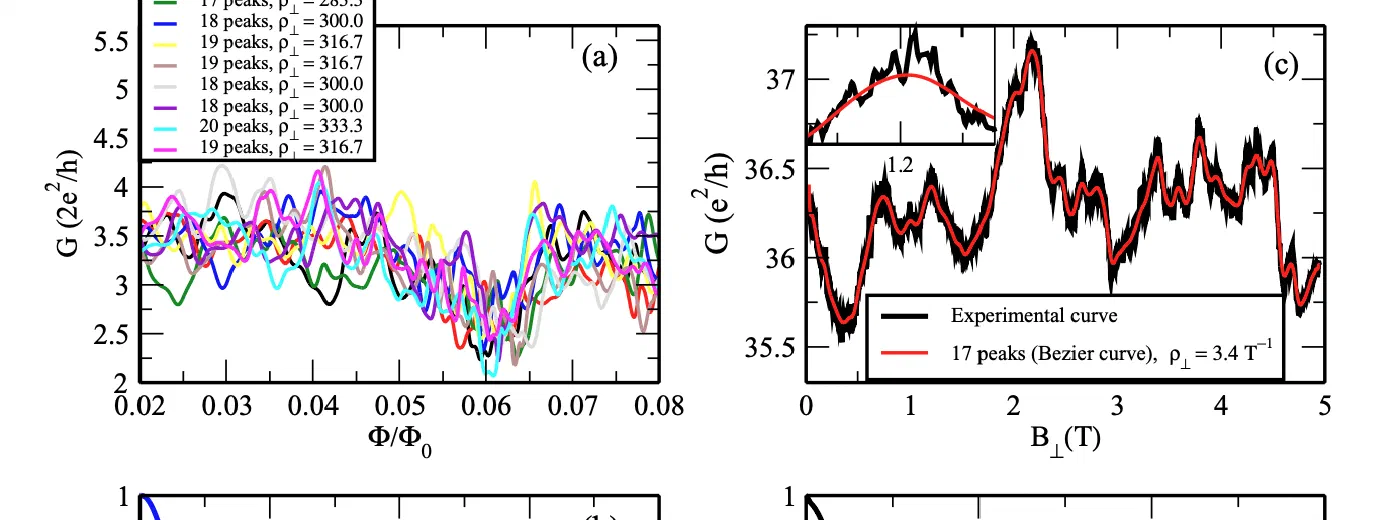
We present a complete numerical calculation and an experimental data analysis of the universal conductance fluctuations in quasi-one-dimension nanowires. The conductance peak density model, introduced in nanodevice research on Phys. Rev. Lett. 107, 176807 (2011), is applied successfully to obtain the coherence length of InAs nanowire magnetoconductance and we prove its equivalence with correlation methods. We show the efficiency of the method and therefore a prominent alternative to obtain the phase-coherence length. The peak density model can be similarly applied to spintronic setups, graphene and topological isolator where phase-coherence length is a relevant experimental parameter.

Turbulence Hierarchy and Multifractality in the Integer Quantum Hall Transition

Barbosa, Anderson L. R., Tiago H. V. de Lima, Iván R. R. González, Nathan L. Pessoa, Antônio M. S. Macêdo, and Giovani L. Vasconcelos. 2022. “Turbulence Hierarchy and Multifractality in the Integer Quantum Hall Transition.” Physical Review Letters 128 (23): 236803..

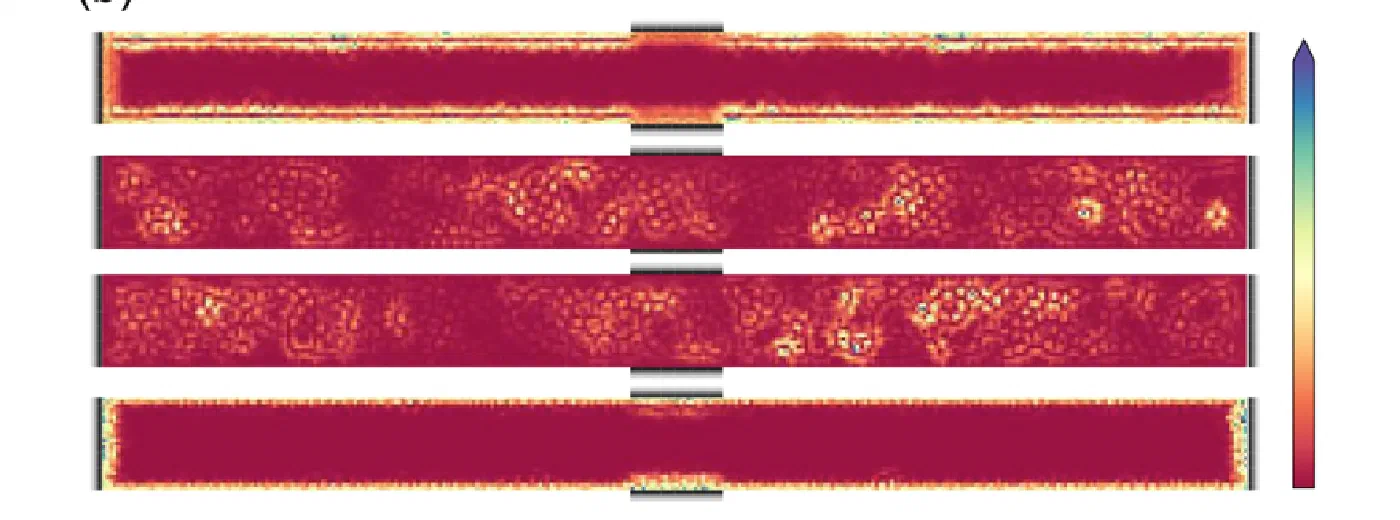
We offer a new perspective to the problem of characterizing mesoscopic fluctuations in the inter-plateau region of the integer quantum Hall transition. We found that longitudinal and transverse conductance fluctuations, generated by varying the external magnetic field within a microscopic model, are multifractal and lead to distributions of conductance increments (magnetoconductance) with heavy tails (intermittency) and signatures of a hierarchical structure (a cascade) in the corresponding stochastic process, akin to Kolmogorov’s theory of fluid turbulence. We confirm this picture by interpreting the stochastic process of the conductance increments in the framework of H-theory, which is a continuous-time stochastic approach that incorporates the basic features of Kolmogorov’s theory. The multifractal analysis of the conductance “time series,” combined with the H-theory formalism provides, strong support for the overall characterization of mesoscopic fluctuations in the quantum Hall transition as a multifractal stochastic phenomenon with multiscale hierarchy, intermittency, and cascade effects.